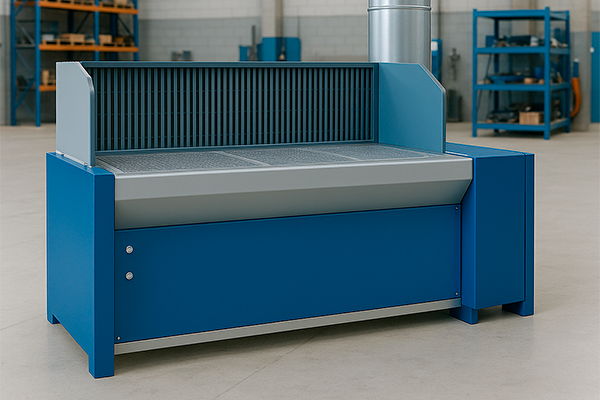
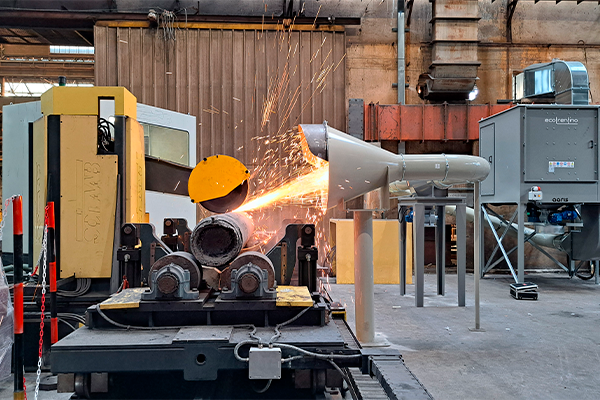
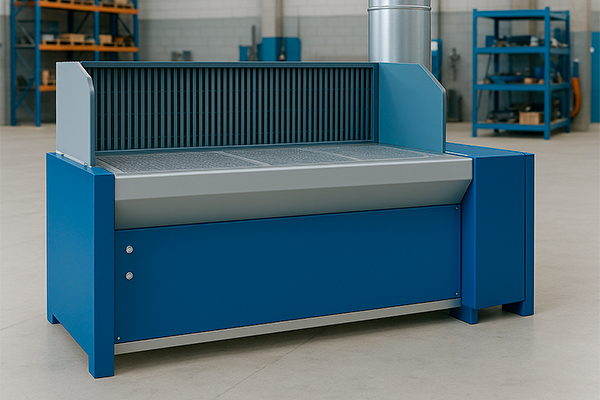
Aeris industrial downdraft tables are designed to ensure effective extraction of dust, fumes, vapours, and oil mist directly at the source. By combining a work surface with an integrated extraction system, they provide efficient contaminant capture while maintaining a clean and safe working environment.
Engineered for a wide range of industrial applications, Aeris downdraft tables ensure maximum operator protection, high performance, and long-term reliability.
What is an industrial downdraft table and how does it differ from a conventional extraction hood?
An industrial downdraft table is a self-contained workstation specifically designed to capture dust, fumes and airborne contaminants directly from the work surface before they can disperse into the surrounding environment. Unlike an overhead extraction hood, which draws contaminants upward through the operator’s breathing zone, a downdraft table extracts the contaminated air downward or horizontally across the work surface. This provides significantly greater protection for the operator while maintaining a clean and safe working area.
Which industrial applications are best suited for a downdraft table?
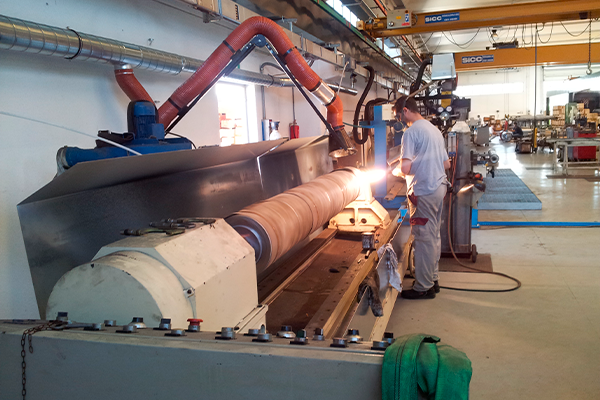
Downdraft tables are the ideal solution for manual or semi-automatic operations that generate localized dust, fumes or airborne contaminants. Typical applications include: • Grinding. • Sanding. • Polishing. • Deburring. • Welding and brazing. • Restoration work. • Powder weighing and transfer operations in the chemical and food industries. They are widely used in metalworking, woodworking, composite materials processing and many other industrial sectors.
Are downdraft tables available with integrated filtration systems, or must they be connected to a central extraction system?
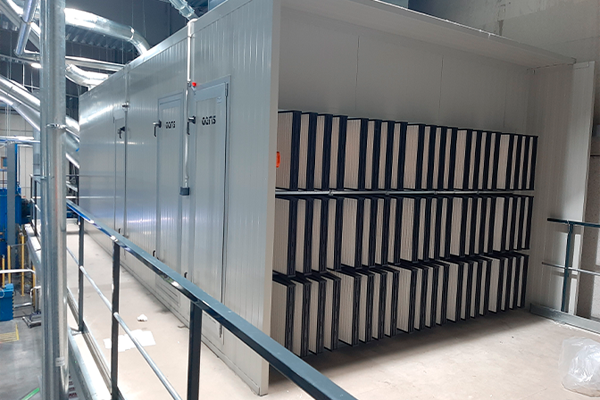
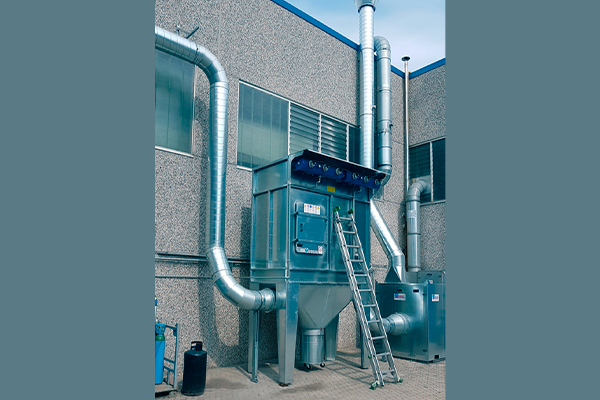
We offer both configurations to suit the specific production and logistical requirements of each facility. Self-contained downdraft tables incorporate an integrated fan together with dedicated filtration systems—typically cartridge filters or pocket filters equipped with either automatic pulse-jet cleaning or manual cleaning systems. These units can be easily installed or relocated by simply connecting them to the electrical and compressed air supply. Alternatively, downdraft tables without integrated filtration are designed to be connected via ductwork to an existing centralized dust extraction and filtration system.
How is safety ensured during processes that generate sparks, such as metal grinding?
Fire protection is integrated directly into the aerodynamic design of the downdraft table. For grinding and cutting applications, the system incorporates a primary mechanical protection stage using metallic spark arrestors or inertial separator cells positioned directly beneath the work surface. These devices intercept and extinguish incandescent particles before they enter the ductwork or reach the main filtration system. When machining highly reactive light metals such as aluminium or magnesium, the potential risk of explosion or hazardous chemical reactions requires additional engineering precautions. In these cases, systems are designed with internal geometries that prevent dust accumulation, together with conductive thermoplastic materials or fully grounded metal structures to eliminate electrostatic charge build-up. Dedicated filtration and explosion protection solutions are selected according to the specific reactivity of the processed material.
What routine maintenance is required to ensure maximum downdraft table performance?
Routine maintenance is simple but essential to maintain consistent extraction performance. Recommended maintenance activities include: • Periodic emptying of the coarse dust collection drawer located beneath the work surface. • Cleaning of the extraction grilles. • Inspection of the internal filters (where installed) by monitoring the system pressure drop. Keeping the extraction grilles free from dust accumulation ensures that the capture velocity remains constant, providing effective protection for the operator throughout the working process.