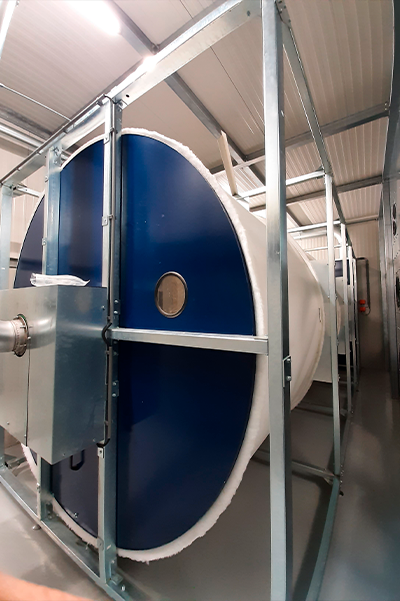
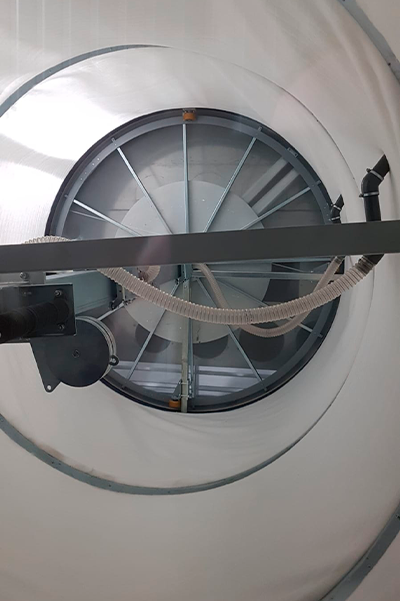
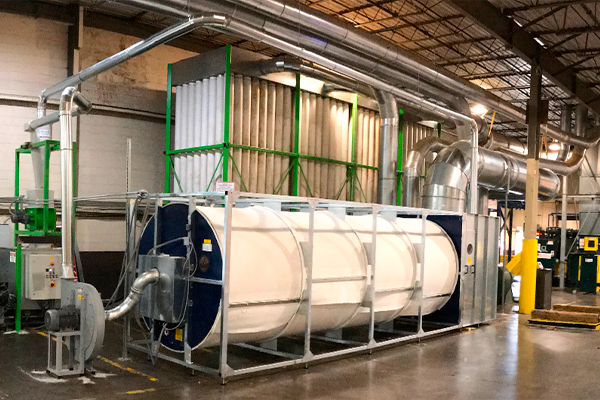
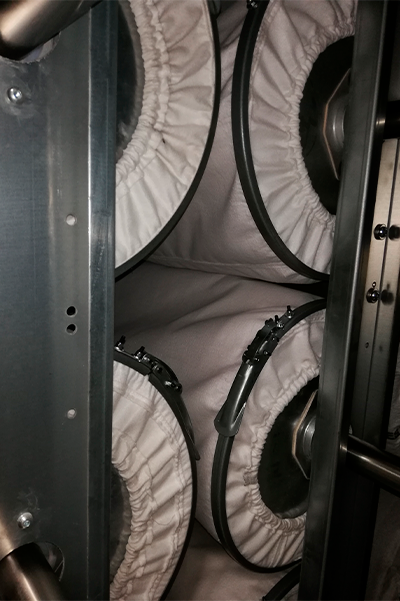
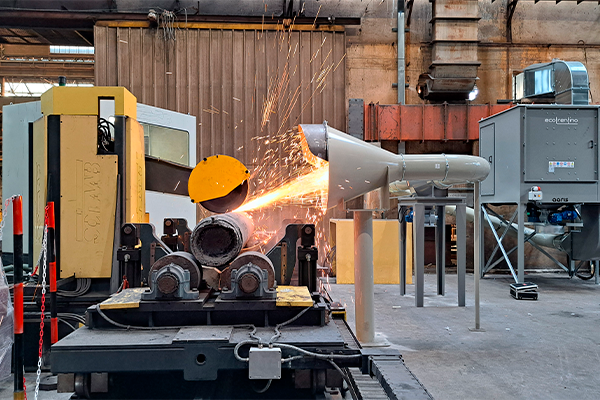
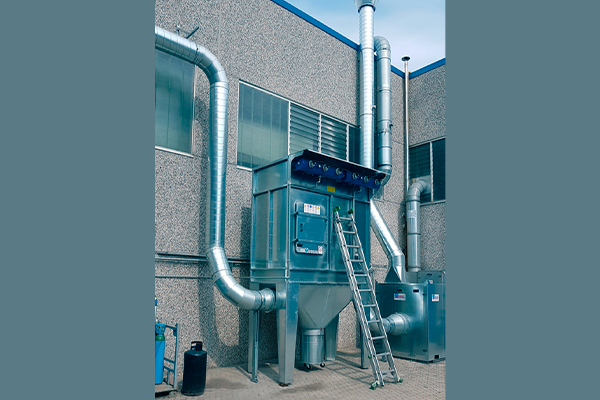
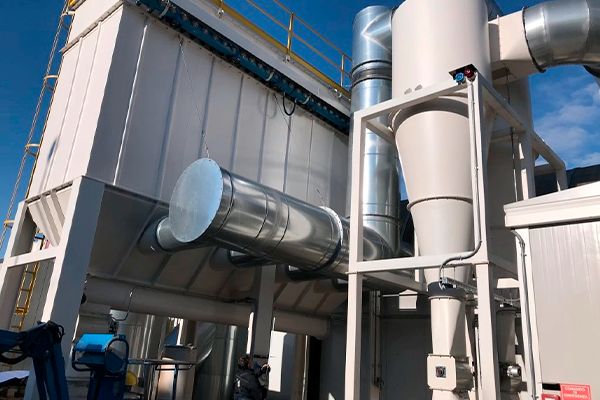
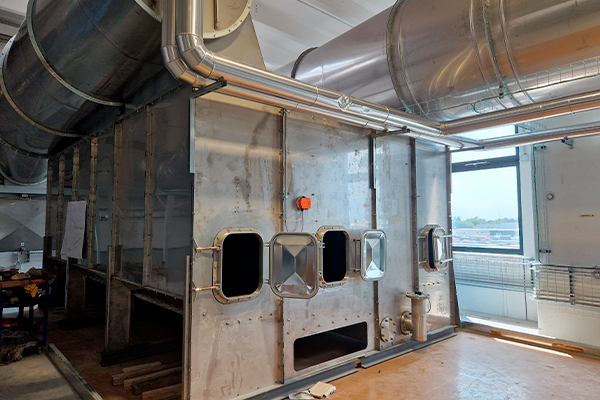
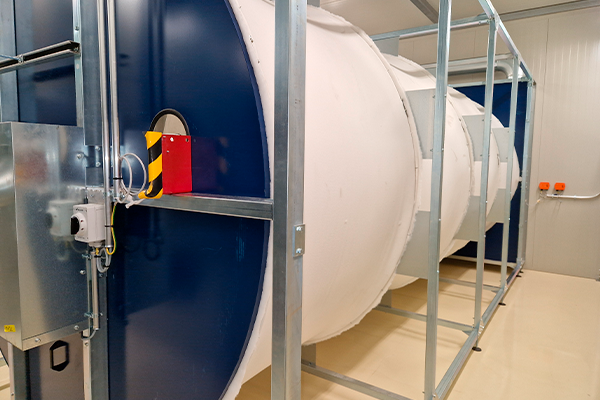
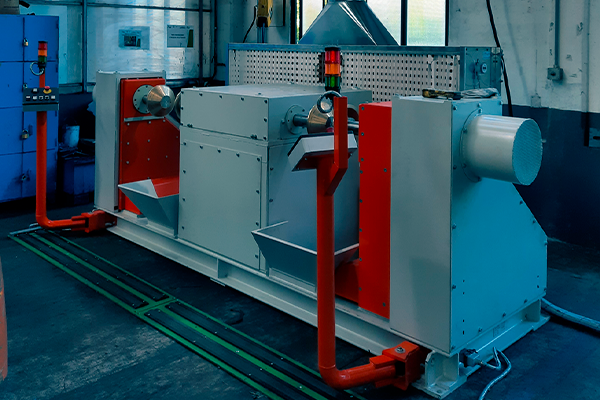
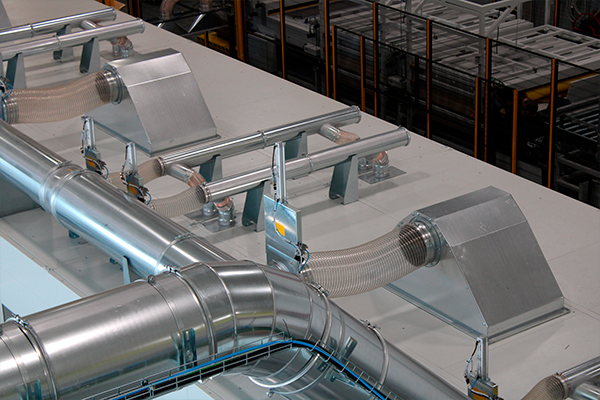
The TFB drum filter is an advanced solution for air filtration in industrial environments with high concentrations of fibres, dust, and coarse particles. Designed to operate in both positive and negative pressure systems, it can be easily integrated into installations of various sizes and airflow capacities, ensuring consistent performance even under demanding operating conditions. The drum consists of a filtration media selected according to the dust characteristics of the process, along with one or more mobile suction nozzles. In the combined TFC version, the system is equipped with a rotating disc pre-filter, designed for the preliminary separation of coarse fibres. During operation, the air to be treated is drawn from the inside to the outside of the drum, passing through the filter media where dust and fine fibres are retained. Inside the drum, one or more mobile suction nozzles continuously remove the accumulated particles through rotational and axial movement, conveying the collected material to dedicated discharge or collection systems. In the TFC version, a rotating disc pre-filter installed at the air inlet captures coarse fibres, which are removed by a fixed suction nozzle and conveyed to dedicated compaction or collection systems.
Clogging control is managed by a differential pressure switch or pressure transmitter, which monitors the permeability of the filter media and signals when replacement is required. The system can be configured in a modular design to handle high airflow capacities.
ADVANTAGES OF DRUM FILTERS
Continuous and efficient filtration of fibres, dust, and process waste, even with high airflow volumes;
Automatic continuous cleaning, with mobile suction nozzles ensuring consistent performance without interruption;
Constantly clean filter chamber, thanks to the airflow from the inside to the outside of the drum;
Integrated pre-filter in the TFC version, ensuring effective separation of coarse fibres;
Reduced energy consumption due to low pressure drop;
Integrated clogging control, enabling predictive maintenance management;
Modular configuration, suitable for different airflow capacities and easy integration into new or existing systems.
AGGIUNGI TESTO
ROTARY DRUM FILTER
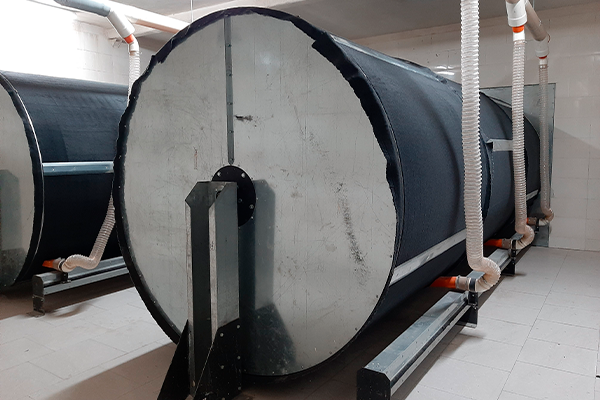
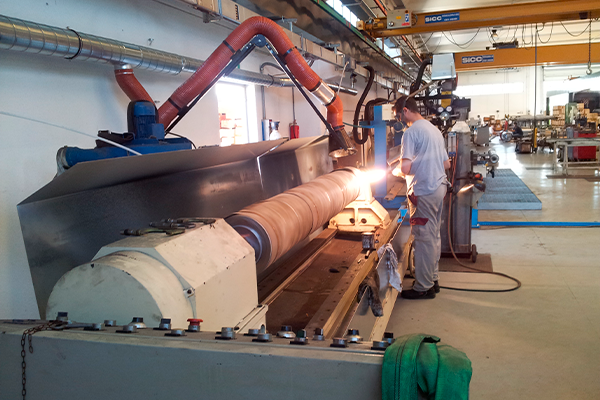
The rotary drum filter is a high-efficiency solution for air filtration in industrial environments, including textile and nonwoven applications, designed to handle large volumes of air containing dust, fibres, and fine particulate. Thanks to its compact and durable construction, it ensures consistent performance even under demanding operating conditions, helping maintain clean and safe working environments. Its modular design and fully automated operation make it ideal for integration into both new and existing systems, offering reduced maintenance requirements and long-term operational reliability. The rotary drum filter consists of a cylindrical metal mesh structure covered with filter media, available in different materials depending on the dust concentration and process requirements. The drum rotates continuously by means of a gear motor driving an anti-friction coated wheel, ensuring stable and uninterrupted operation.
Contaminated air is drawn through the drum from the outside to the inside by the negative pressure generated by the fan. During this process, dust and fibres are retained on the external surface of the filter media. Automatic cleaning is performed by one or more suction nozzles that move axially along the drum, continuously removing accumulated particles and conveying them to dedicated collection systems. Clogging is monitored by a differential pressure switch or pressure transmitter, which measures the permeability of the filter media and signals when replacement is required. For high airflow applications, the system is also available in a modular configuration, providing maximum filtration surface area while maintaining compact overall dimensions.enute.
ADVANTAGES OF THE ROTARY DRUM FILTER
Continuous and efficient filtration of dust and particulate, even at high airflow volumes;
Self-cleaning system with mobile suction nozzles, minimising maintenance and ensuring consistent performance;
Energy savings due to low pressure drop and aerodynamically optimised design;
Flexible installation, available in ambient or ducted configurations, including modular versions for high airflow capacities;
Durable construction, with galvanised steel components and filter media selected according to the specific process requirements;
Integrated clogging control with differential pressure switch or pressure transmitter.
MULTI-DRUM FILTER
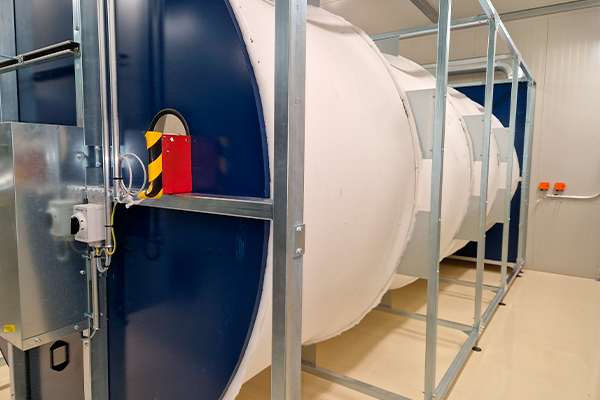
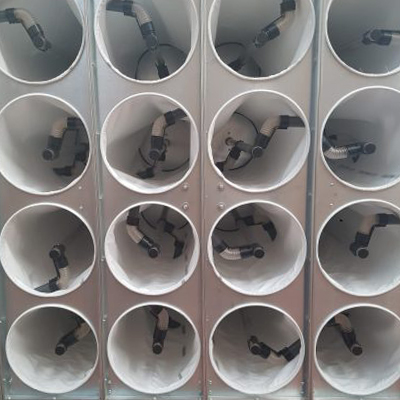
The multi-drum filter is an advanced solution for air filtration in industrial environments with high concentrations of fibres, dust, and coarse particles. Designed to operate in both positive and negative pressure systems, it ensures effective filtration with a compact design and energy-efficient operation. During operation, the air to be treated is drawn from the inside to the outside of the drums, passing through the filter media where dust and fine fibres are retained. Inside each drum, two mobile suction nozzles continuously remove the accumulated particles through axial movement, conveying the collected dust to dedicated discharge or collection systems.
Clogging is monitored by a differential pressure switch or pressure transmitter, which measures the permeability of the filter media and signals when replacement is required. The system can be installed in a modular configuration to handle high airflow capacities.
ADVANTAGES OF THE MULTI-DRUM FILTER
High filtration efficiency, compliant with ISO 16890, up to PM1 70–85%;
Continuous cleaning at controlled and adjustable intervals, ensuring stable pressure conditions;
Clean filtration chamber, as airflow passes from the inside to the outside of the drums;
Extended service life of the filter media;
Low pressure drop and reduced energy consumption;
Easy maintenance, with all drive components located on the clean air side;
Quick and easy replacement of filter media;
Compact design, suitable for installation in environments with limited space.
OUR PROJECTS
Aeris rappresenta un partner ideale per tutte le aziende che cercano efficienza, qualità, sicurezza e innovazione.
Request a free, personalised technical evaluation to identify the most suitable filtration solution for your application.
What is the operating principle of a drum filter and how does it ensure continuous operation?
A drum filter (also known as a rotary drum filter) operates by means of a rotating cylindrical drum covered with a high-efficiency filter media. Dust-laden air flows either inside or outside the rotating drum, where particulate is retained by the filter media while the cleaned air continues through the system. The key advantage of this technology is its continuous operation. As the drum rotates slowly, a system of fixed suction nozzles mounted on the frame continuously removes the accumulated dust cake from the filter media. Unlike cyclic filtration systems that require intermittent cleaning cycles or production interruptions, this continuous cleaning process prevents pressure fluctuations and ensures uninterrupted airflow.
Which industrial applications are best suited for rotary drum filters?
Rotary drum filters are the preferred solution for applications involving large air volumes containing coarse dust, fibres, lint and lightweight bulky materials. Typical industries include: • Textile and nonwoven manufacturing (fibres, filaments and lint collection). • Paper and cardboard production (trim waste, paper dust and bulky rejects). • Recycling and waste treatment. • Selected food processing applications. The rotating drum design prevents difficult materials from wrapping around or clogging the filter media, a common issue with conventional bag or cartridge filtration systems.
What are the main advantages of drum filters in terms of footprint and airflow capacity?
Drum filters provide an outstanding ratio between treated airflow capacity and installation footprint. Thanks to their cylindrical geometry and continuous filter media regeneration, they can handle extremely high airflow rates while maintaining low and stable pressure drop. The low airflow resistance also results in significant energy savings by reducing the power required by the main system fans. Compared to conventional filtration systems equipped with multiple filter elements, maintenance is greatly simplified, as operators only need to monitor a single large filter element instead of hundreds of individual filter bags.
Can drum filters be used as the only filtration stage, or do they require secondary filters?
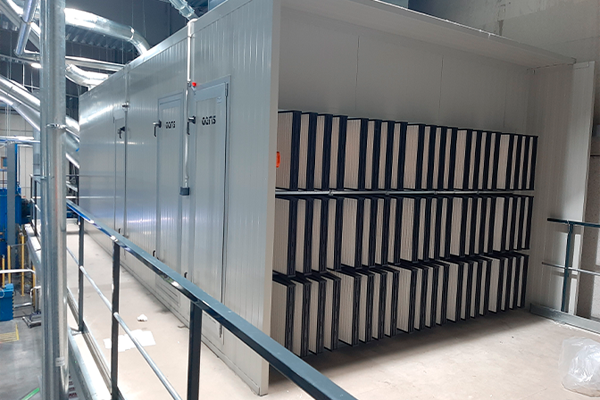
The answer depends on the particle size distribution and the required emission limits. For fibres, shavings, lint and coarse dust, a drum filter can operate as the sole filtration stage while delivering very high collection efficiency. However, when the air stream also contains significant quantities of fine or submicron particles, the drum filter is typically used as an efficient primary separation stage, followed by a secondary fine filtration system—such as pocket filters or bag filters—before the cleaned air is discharged into the atmosphere.
What routine maintenance is required for a rotary drum filter?
Routine maintenance requirements are limited but focus on the system’s mechanical components. Recommended maintenance activities include: • Periodic inspection of the drum drive system, including the motor, belts or chains. • Verification of the service fans supplying the suction nozzles used for continuous filter media cleaning. • Visual inspection of the filter media to detect tears or localized wear. Continuous monitoring of the differential pressure enables the system to automatically detect any anomalies in the self-cleaning cycle or potential damage to the filter media.